Green Energy PowerPoint Template
Imagine launching a solar startup pitch with slides that breathe clarity—not clutter. Or guiding a city council through a net-zero roadmap without drowning them in dense text. That’s what Green Energy PowerPoint delivers: a clean, purpose-built presentation template designed not just to look eco-conscious, but to communicate sustainability ideas with precision, confidence, and quiet authority.
This isn’t another generic “green-themed” deck with recycled leaf icons and faded gradients. Green Energy PowerPoint is built from the ground up for people who work *in* and *for* the green economy—solar developers explaining ROI to investors, environmental educators simplifying carbon metrics for high school students, climate campaign leads aligning volunteers around phased action plans, or energy consultants visualizing grid transition scenarios for municipal stakeholders.
What Makes It Work Beyond Aesthetics
The strength of Green Energy PowerPoint lies in its functional architecture. Every slide serves a communicative goal:
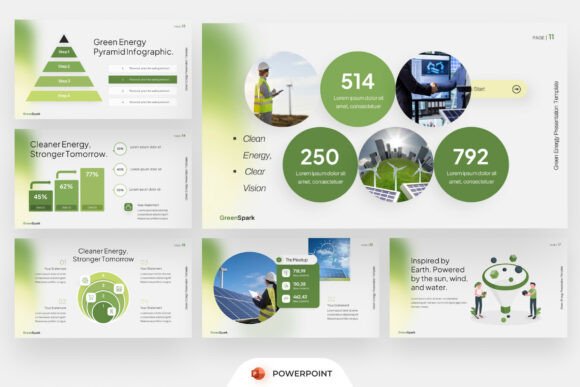
- Infographic layouts turn complex data—like renewable adoption rates or lifecycle emissions comparisons—into instantly scannable visuals;
- Data visualization sections support bar charts, trend lines, and comparative gauges—all fully editable in PowerPoint, no design software needed;
- Service highlight pages let clean tech firms showcase offerings (e.g., “EV charging infrastructure audits” or “building energy retrofit packages”) with consistent spacing, icon alignment, and typographic hierarchy;
- Roadmap elements provide flexible, timeline-based frameworks—ideal for illustrating multi-year decarbonization pathways, grant-funded project milestones, or product development sprints for green hardware startups;
- Corporate presentation pages include title slides, team bios, methodology overviews, and appendix-ready summary slides—structured for credibility and flow.
All slides are 16:9 widescreen, fully editable, and ship with a free, modern sans-serif font already embedded—no licensing surprises or missing typeface errors mid-edit. The Help Guide files walk users through customizing color palettes, swapping placeholder content, adjusting chart axes, and maintaining visual consistency across 20+ slides.
Creative Uses Across Real Roles
How you use Green Energy PowerPoint depends less on your title and more on your intent—and that’s where flexibility meets intentionality.
For educators and trainers: Swap out stock imagery placeholders with classroom photos, student project snapshots, or local watershed maps. Use the “Before/After” comparison layout to show real-world impact—e.g., “A community garden’s soil health improvement over 18 months,” paired with simple bar charts tracking biodiversity gains.
For freelancers and designers: Treat it as a client-ready foundation—not a final product. Customize the palette to match a brand’s existing identity (e.g., shift from forest green to ocean blue for a marine conservation NGO), then layer in original illustrations or simplified vector icons. Because all shapes and text boxes are native PowerPoint objects, clients can update stats or messaging themselves post-delivery.
For small business owners and solopreneurs: Repurpose slides across formats. Turn the “Our Process” roadmap into a printed one-pager for trade shows. Convert the “Impact Metrics” slide into a social media carousel (export each chart as PNG, add concise captions). Use the clean title slide + bullet-point structure for investor email summaries—just paste the core message directly from the slide notes.
For marketers and campaign leads: Leverage the template’s built-in narrative logic. Start with a problem slide (“Energy poverty affects 759M people globally”), follow with a solution framework (your org’s decentralized microgrid model), then reinforce with localized data points and a clear call-to-action—“Join our pilot cohort in rural Kenya.” Consistency in layout builds trust; clarity in progression drives action.
Keeping It Clear, Consistent, and Audience-Focused
A powerful template only works when used thoughtfully. Here’s how to stay grounded:
- Lead with audience need, not feature count. A municipal planner reviewing a solar feasibility report cares about land-use tradeoffs and permitting timelines—not animation effects. Skip transitions. Prioritize labeled charts, plain-language summaries, and clear section headers.
- Edit ruthlessly—even in editable templates. Delete slides you don’t need. Consolidate overlapping points. Replace vague phrases like “leverage synergies” with concrete actions: “Install 42 rooftop PV systems by Q3 2025, reducing district emissions by 18%.”
- Maintain visual rhythm. Use the template’s built-in grid and spacing guides (visible when editing) to align text blocks, icons, and charts. If adding new images, keep aspect ratios uniform—crop to 4:3 or 16:9 to avoid distortion.
- Anchor data in context. Don’t just show a rising line chart for wind capacity—add a short footnote: “Based on IEA 2023 Renewables Report; reflects installed capacity, not generation.” Credibility grows from transparency, not polish.
Remember: You’re not selling a template—you’re enabling better communication about urgent, tangible work. Whether you’re briefing a school board on composting infrastructure or pitching battery storage integration to utility executives, Green Energy PowerPoint gives you scaffolding—not script. Your voice, your data, your mission remain center stage.
Getting Started Without Overwhelm
You don’t need design expertise to begin. Open the PowerPoint file. Scan the slide titles. Identify the three slides most critical to your next presentation—maybe the “Project Roadmap,” “Key Services,” and “Impact Summary.” Duplicate those. Delete the rest. Fill in your content using short sentences and active verbs. Adjust colors once—using the built-in theme editor—to reflect your organization’s palette or campaign tone (e.g., muted sage for regenerative agriculture, crisp teal for water-tech innovation).
Then step back. Ask: Does someone scanning this for 10 seconds grasp the core idea? Does each chart answer a specific question? Is the next action obvious? If yes—you’ve used Green Energy PowerPoint exactly as intended: as a tool that serves clarity, not decoration.
It won’t replace deep subject knowledge or thoughtful strategy. But it removes friction between insight and influence—so your renewable energy vision lands with the weight it deserves.