Global Rabies Day Flyer Template: A Practical Tool for Community-Led Rabies Prevention
Rabies remains one of the most fatal infectious diseases known to humans—yet it is 100% preventable. Every year on September 28, Global Rabies Day unites health professionals, veterinarians, educators, and community leaders in a shared mission: to eliminate rabies through awareness, education, and action. But turning that mission into measurable impact requires more than goodwill—it demands clear, credible, and culturally resonant communication. That’s where the Global Rabies Day Flyer Template steps in—not as a generic design, but as a purpose-built, data-informed resource tailored for real-world public health outreach.
Organizations working at the frontline—whether a rural veterinary NGO coordinating mass dog vaccinations, a municipal health department launching an urban awareness drive, or a university-led animal health education initiative—often face overlapping challenges: tight budgets, limited design capacity, inconsistent messaging, and urgent timelines. They need materials that are scientifically accurate, visually engaging, and instantly adaptable to local languages, contexts, and logistical realities. Too often, teams spend days designing from scratch—or worse, rely on outdated or oversimplified visuals that fail to convey urgency or actionable steps. The result? Lower engagement, reduced vaccine uptake, and missed opportunities to build long-term community trust.
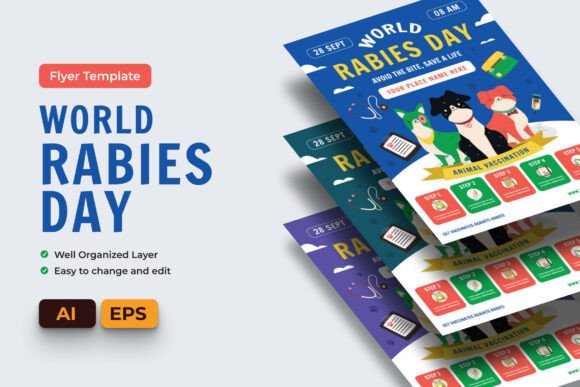
The Global Rabies Day Flyer Template directly addresses these pain points by providing a ready-to-use foundation grounded in public health best practices. It’s not just a layout—it’s a strategic communication framework. Its clean, illustrated design uses infographic-style health statistics (e.g., “1 person dies of rabies every 9 minutes,” “99% of human cases stem from dog bites”) to anchor facts in emotional resonance and visual clarity. Prevention messaging is prioritized—not buried—and structured around three pillars: educate, vaccinate, and act. This structure helps audiences quickly grasp both the stakes and the solutions—no medical jargon, no ambiguity.
What makes this template especially effective is its intentional flexibility. Available in three coordinated color alternatives—calm blue (for clinical credibility), warm amber (for community warmth), and high-contrast green (for visibility in outdoor settings)—it adapts seamlessly to different audience expectations and environmental conditions. A public health agency distributing flyers at a city clinic might choose the blue variant to reinforce professionalism and trust. Meanwhile, a grassroots animal welfare group hosting a weekend vaccination fair in a market square may opt for the green version to ensure legibility under sunlight and draw attention amid visual noise.
Practical application begins with customization—and the Global Rabies Day Flyer Template is built for it. Delivered in editable Adobe Illustrator (Ai) and EPS formats—both A4 size, CMYK, 300 DPI, with full bleed and well-organized layers—it supports professional printing without quality loss. All fonts used are free and widely available, eliminating licensing hurdles or font substitution errors. Crucially, no stock imagery is embedded, giving users full control over visual representation: a Kenyan team can insert photos of local vaccinators and community elders; a Southeast Asian coalition can feature native dog breeds and bilingual text; a Latin American municipality can integrate regional health authority logos and QR codes linking to mobile-friendly vaccination schedules.
Outcomes are tangible. When a veterinary association in Nepal used the template to support a district-wide “Rabies-Free Village” campaign, they reported a 42% increase in caregiver attendance at educational sessions—and a 37% rise in dog registration and vaccination rates within six weeks. In Colombia, a network of community health workers adapted the flyer for low-literacy audiences by simplifying icons, adding pictograms for post-exposure prophylaxis steps, and translating key messages into Wayuunaiki. Their follow-up survey showed improved recall of bite-response actions among 78% of participants—up from 31% pre-campaign.
Different users approach the Global Rabies Day Flyer Template with distinct priorities—and that’s by design. Public health departments value its alignment with WHO and OIE (WOAH) rabies elimination guidelines, making it easy to integrate into broader One Health strategies. Veterinary associations appreciate the emphasis on responsible pet ownership and accessible canine vaccination pathways. NGOs and faith-based groups highlight how the clean layout leaves space for localized testimonials, religious endorsements, or stories of survivorship that deepen cultural relevance. Even schools and youth clubs use simplified versions of the template to co-create posters with students—turning awareness into active citizenship.
To maximize impact, consider these practical recommendations:
- Localize beyond translation: Adapt statistics to reflect national or subnational rabies burden data where possible—even citing recent outbreak locations builds immediacy.
- Layer in clear calls to action: Use the template’s designated zones to add specific dates, venues, and contact details for vaccination drives, hotline numbers, or SMS-based reporting tools.
- Pair with behavior-focused messaging: Instead of “Avoid stray dogs,” try “If bitten: wash thoroughly with soap and water for 15 minutes—then seek care immediately.” Clarity saves lives.
- Print smartly: Leverage the included Help Guide File to understand layer naming conventions, color separation tips, and safe margins—especially important when working with local print vendors who may lack design expertise.
Importantly, the Global Rabies Day Flyer Template does not replace expertise—it amplifies it. It empowers non-designers to communicate like professionals and enables subject-matter experts to focus on what they do best: delivering care, training field staff, and building community resilience. Its strength lies not in decorative flair, but in functional precision: every element serves a communicative purpose, every color choice supports readability and tone, and every layout decision reflects evidence on health behavior change.
As global efforts accelerate toward the 2030 goal of zero human rabies deaths, tools like this template become critical infrastructure—not just for awareness, but for accountability, equity, and action. Whether you’re planning your first neighborhood vaccination day or scaling a national campaign across multiple provinces, the Global Rabies Day Flyer Template offers consistency without rigidity, science without stiffness, and urgency without alarmism. It meets communities where they are—with respect, relevance, and readiness to act.
Because preventing rabies isn’t about perfect graphics. It’s about clear information, delivered clearly—so everyone knows exactly what to do, when to do it, and why it matters.