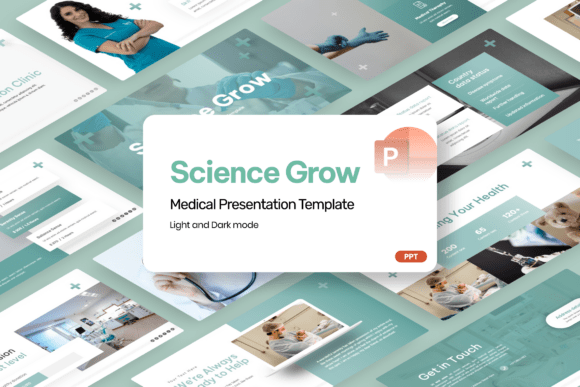
Science Grow PowerPoint: A Modern Medical Presentation Template Built for Clarity and Confidence
In today’s fast-paced healthcare environment—where time is scarce, data is abundant, and stakeholder expectations are higher than ever—how you present information matters as much as the information itself. Whether you’re a hospital administrator briefing the board on patient throughput metrics, a startup founder pitching a new telehealth platform to investors, or a nursing educator preparing a lecture on post-acute care pathways, your slides must communicate authority, empathy, and precision. That’s where Science Grow PowerPoint steps in—not as another generic template, but as a purpose-built tool grounded in clinical realism and design intelligence.
More Than Just “Medical-Themed” Slides
Many presentation templates claim to serve healthcare professionals, yet most rely on clichéd imagery (stethoscopes over blue gradients) and rigid, outdated layouts that hinder rather than help storytelling. Science Grow PowerPoint breaks from that pattern. It’s designed with soft clinical aesthetics—think muted teals, warm greys, and breathable white space—not sterile minimalism. Its visual language reflects how modern medicine actually looks and feels: collaborative, human-centered, and data-informed. The layouts avoid clutter without sacrificing detail, supporting everything from complex patient cohort analytics to step-by-step wellness campaign rollouts.
What sets it apart isn’t just appearance—it’s intentionality. Each slide is fully editable in standard PowerPoint, built at 16:9 widescreen ratio for seamless projection and screen sharing. Fonts are included and license-free, eliminating last-minute font substitution headaches. There’s no locked content, no hidden layers, no reliance on external plugins—just clean, intuitive structure ready for customization in minutes.
Why Now? Aligning With Evolving Healthcare Communication Needs
Healthcare communication has shifted dramatically in the past five years. Remote consultations, hybrid team meetings, and digital-first patient engagement are no longer exceptions—they’re standards. At the same time, audiences—from clinicians reviewing quarterly performance dashboards to community health workers explaining vaccine uptake trends—expect clarity, not jargon. They want visuals that clarify relationships, not obscure them. Infographics aren’t decorative extras anymore; they’re essential translation tools between raw data and actionable insight.
Science Grow PowerPoint meets this moment by embedding modern infographic elements directly into its architecture: timeline slides for treatment pathway mapping, comparative bar charts styled for clinical context, modular dashboard frames for KPI tracking, and responsive layout grids that adapt whether you’re presenting to 3 people in a clinic huddle or 300 via webinar. It doesn’t assume technical fluency—its Help Guide files walk users through common customizations, like swapping color palettes to match an organization’s brand or reformatting a patient satisfaction graph without rebuilding from scratch.
Real-World Use Across Diverse Healthcare Roles
The versatility of Science Grow PowerPoint becomes evident when you consider who uses it—and how:
- Hospitals & Health Systems: Streamline monthly quality improvement reports using pre-formatted slides for readmission rate trends, staffing ratios, and infection control metrics—without redesigning each quarter.
- Clinics & Private Practices: Build consistent, branded patient education decks—say, explaining diabetes management plans—with clear icons, progressive disclosure layouts, and accessible contrast.
- Pharmaceutical & MedTech Teams: Present clinical trial summaries or market access dossiers using structured comparison slides that highlight efficacy, safety, and real-world evidence side by side.
- Nursing & Allied Health Educators: Develop curriculum-aligned presentations with built-in case study frameworks, anatomy overlays (using your own images), and reflective discussion prompts—all within a cohesive visual system.
- Healthcare Startups: Pitch to payers, providers, or regulators using slides that balance innovation storytelling with clinical credibility—no need to choose between “visionary” and “trustworthy.”
This isn’t theoretical utility. Users report cutting average deck creation time by 40–60% compared to starting from blank slides—time redirected toward refining messaging, validating data sources, or rehearsing delivery. In an industry where miscommunication can have tangible consequences, consistency and speed reinforce reliability.
Design That Supports, Not Overrides, Your Expertise
A good medical presentation template shouldn’t compete with your knowledge—it should elevate it. Science Grow PowerPoint avoids over-designed flourishes that distract from content. Its “hospital-inspired compositions” refer to thoughtful spatial hierarchy: titles positioned for quick scanning, body text sized for readability at distance, and image placeholders sized to accommodate real clinical photos (e.g., wound healing progressions, device interfaces, facility maps) without cropping or distortion. Even the subtle use of line weight and icon stroke width follows accessibility best practices—ensuring slides remain legible for viewers with mild visual impairments or under less-than-ideal lighting.
Importantly, all stock imagery is excluded from the package—a deliberate choice. It respects user autonomy and compliance needs. You bring the authentic visuals: your hospital’s interior shots, your EHR dashboard exports, your patient consent-approved illustrations. The template provides the scaffolding; you supply the substance.
Practical Customization Without Technical Overhead
“Fully editable” means more than just text boxes you can click. In Science Grow PowerPoint, shapes, icons, and chart elements retain their native PowerPoint functionality. Change a bar chart’s data source? Done in two clicks. Swap a color scheme across 20 slides? Use Slide Master with confidence. Adjust spacing in a multi-column wellness campaign layout? Drag and snap—no pixel-perfect alignment required.
The included Help Guide files aren’t marketing fluff. They contain annotated screenshots showing exactly how to replace placeholder graphics, adjust gradient transparency for softer emphasis, or convert a static flowchart into an animated sequence—using only native PowerPoint features. No third-party add-ins. No design degree needed. Just focused, practical guidance for people who value efficiency and control.
Looking Ahead: Sustainability in Healthcare Design
As AI-assisted content generation grows, templates like Science Grow PowerPoint take on renewed importance—not as replacements for human judgment, but as guardrails against homogenization. When every hospital, startup, or academic department uses the same AI-generated slide deck, differentiation blurs. What remains distinctive is how thoughtfully you apply structure: which data points you foreground, how you sequence a narrative about care coordination, where you pause for reflection in a training module. This template gives professionals the quiet confidence to focus on those decisions—knowing the foundation is both professional and adaptable.
It also reflects a broader shift toward sustainable creative workflows. Rather than downloading dozens of incompatible templates and stitching them together, users invest once in a coherent system that scales with their needs—whether presenting to a local PTA about mental health literacy or submitting a grant application to NIH. That continuity builds institutional memory and reduces cognitive load across teams.
Ultimately, Science Grow PowerPoint succeeds because it understands that in healthcare, trust is earned through clarity—not complexity. It doesn’t promise to make you a designer. It promises to help you communicate with greater impact, day after day, meeting after meeting, patient after patient.