Military Rifle SVG Collection
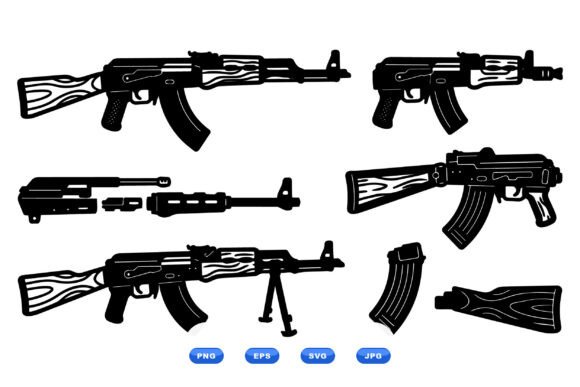
The Military Rifle SVG Collection is a curated set of 100 scalable vector illustrations depicting assorted assault rifle outlines. Each design features a bold, stencil-style silhouette with deliberately detached stocks and magazines—emphasizing modular components while maintaining clean, editorial-grade visual clarity. The collection is delivered as an instant-download ZIP file containing SVG (Scalable Vector Graphics), EPS (Encapsulated PostScript), transparent-background PNG, and standard JPG preview files.
This resource is intended for designers, educators, content creators, and makers who require precise, adaptable firearm imagery for non-commercial or permitted editorial, informational, or design applications. It is not intended for use in promotional material that glorifies violence, misrepresents real-world weapons systems, or violates platform-specific content policies.
Who Might Consider the Military Rifle SVG Collection?
Individuals evaluating this collection typically fall into several overlapping categories:
- Educators and curriculum developers creating infographics about defense technology, historical arms evolution, or mechanical engineering principles;
- Graphic designers working on military-themed publications, museum exhibits, or documentary visuals requiring consistent, scalable iconography;
- DIY crafters and small-business owners using cutting machines (e.g., Cricut, Silhouette) to produce decals, apparel, or packaging with technical or tactical aesthetics;
- Digital artists and illustrators seeking editable base assets to customize, layer, or integrate into larger compositions.
Interest often arises from a need for visual accuracy without licensing complexity—particularly when stock photo alternatives lack scalability, modularity, or stylistic cohesion.
Key Benefits
The primary advantages of the Military Rifle SVG Collection stem from its format and structure:
- Scalability without quality loss: SVG and EPS formats retain sharpness at any size—critical for large-format printing or high-resolution digital displays;
- Editability: Vector paths can be modified in software like Adobe Illustrator or Inkscape—allowing adjustments to line weight, color, component grouping, or proportions;
- Component separation: Detached stocks and magazines support modular illustration workflows—enabling clear visual explanations of weapon assembly, maintenance, or design variation;
- Cross-platform compatibility: Includes widely supported formats suitable for both professional design tools and consumer-grade cutting machines;
- Consistent visual language: Uniform stencil styling ensures coherence across multi-image layouts, reducing time spent harmonizing disparate assets.
Tradeoffs and Practical Considerations
While useful, the collection has inherent limitations that affect suitability for specific goals:
First, the stylized, black-silhouette aesthetic prioritizes clarity over photorealism. Users needing detailed surface textures, lighting effects, or perspective-accurate 3D representation will find these vectors insufficient without significant post-processing.
Second, the designs depict generic assault rifle outlines—not licensed or manufacturer-specific models. They avoid branding, serial markings, or proprietary features. This supports broad usability but limits applicability in contexts requiring model fidelity—such as technical manuals, forensic visualization, or military simulation interfaces.
Third, usage rights are restricted to permitted editorial, educational, and design purposes. Commercial deployment—for example, on merchandise sold to end consumers—requires careful review of applicable copyright and platform policies. Some marketplaces prohibit firearm-related imagery entirely, regardless of artistic treatment.
Finally, the collection assumes baseline familiarity with vector editing tools. Beginners may need time to learn how to ungroup layers, adjust anchor points, or export correctly for their intended output medium.
When the Military Rifle SVG Collection Is a Strong Fit
This collection works well when your goal involves:
- Creating standardized, repeatable visuals for comparative analysis—e.g., side-by-side illustrations of rifle ergonomics or modularity across generations;
- Developing instructional materials where conceptual clarity outweighs realism—such as explaining gas-operated reloading cycles or magazine feed mechanisms;
- Producing physical outputs via vinyl cutters or laser engravers, where crisp vector edges and simple shapes improve cutting accuracy and reduce material waste;
- Building reusable design systems—where consistent stroke width, negative space, and component alignment streamline future asset creation.
In such cases, the collection’s emphasis on structural legibility and technical neutrality supports efficient, repeatable workflows.
When Alternatives May Be More Appropriate
Consider other resources if your project requires:
- Photographic realism: High-resolution reference images or 3D model libraries (e.g., TurboSquid, CGTrader) offer greater detail for rendering, animation, or simulation—but lack the immediate editability of vectors;
- Specific model accuracy: Manufacturer-provided technical drawings or CAD files provide exact dimensions and tolerances, though access is often limited to authorized entities;
- Animated or interactive elements: SVG alone does not support motion; projects needing interactivity (e.g., rotating components, hover states) benefit from complementary web development tools or specialized animation software;
- Broader weapon typology: If your work spans pistols, machine guns, or historical firearms beyond modern assault rifles, a more comprehensive vector library—or multiple targeted collections—may better serve long-term needs.
Making an Informed Decision
To determine whether the Military Rifle SVG Collection aligns with your objectives, ask:
- What is the core purpose of the imagery? If it’s to clarify function, compare form, or support scalable production, vectors are appropriate. If it’s to evoke realism or emotional response, photography or rendered 3D may be preferable.
- What output formats do you need? Confirm compatibility with your tools: SVG for web and editing, EPS for print workflows, PNG for quick placement in presentations or social media.
- How much customization is required? Assess whether built-in modularity (e.g., separate stock/magazine layers) matches your editing capacity and timeline.
- What are your distribution channels? Review platform guidelines—especially for e-commerce, education platforms, or social media—to ensure compliance before finalizing design choices.
No single asset library meets every need. The value of the Military Rifle SVG Collection lies in its focused utility: a reliable, technically grounded foundation for visual communication where precision, consistency, and adaptability matter more than decorative detail.